

Table of Contents
- Why Daily Migraine Supplements Work Differently Than Acute Medication
- Natural Supplements for Migraine Frequency Reduction: What the Evidence Shows
- Magnesium for Migraine Prevention Dosage: Forms, Amounts, and Timing
- Melatonin and Vitamin D3
- How to Choose a Migraine Supplement: A Practical Framework
- Combination Migraine Supplements Compared: Pros and Cons
- Side Effects, Drug Interactions, and Who Should Ask a Doctor First
- Frequently Asked Questions
Last Updated: September 30, 2026
Why Daily Migraine Supplements Work Differently Than Acute Medication
Daily migraine supplements are preventive tools, not rescue drugs. They work by steadily raising nutrient levels in your body to reduce how often migraines strike, rather than stopping an attack already in progress. This guide from the creators of MigraineMD explains how to choose the best migraine supplements for daily use.

Acute medication treats pain after it starts. A daily regimen aims to change the underlying conditions that trigger attacks in the first place. That difference matters because prevention targets frequency, while acute treatment targets the current episode.
Migraine is a neurological condition involving altered brain excitability and mitochondrial energy production. Many people with frequent migraines run low on key nutrients that support nerve and muscle function. Correcting those gaps takes weeks to months, not hours.
That explains why consistency beats intensity with migraine supplements.
Natural Supplements for Migraine Frequency Reduction: What the Evidence Shows
The 3 most studied natural supplements for migraine frequency reduction are riboflavin, magnesium, and coenzyme Q10. Additional evidence supports the use of vitamin D3 and melatonin. Each supports the brain's energy systems and nerve signaling in a different way, and each has a dose range that clinical researchers have actually tested.
A common mistake is expecting one ingredient to fix everything. In practice, these nutrients work as a team, and that is why combination formulas tend to outperform single-ingredient pills.
Riboflavin & CoQ10: The Mitochondrial Connection
Mitochondrial dysfunction is a proposed driver of migraine, where brain cells struggle to produce enough energy during an attack. Riboflavin (vitamin B2) and coenzyme Q10 all support mitochondrial function.
Here is what the research actually tested:
- Riboflavin: Trials commonly used 400 mg per day. At that dose, riboflavin supports the flavoprotein complexes that help mitochondria convert food into usable energy. It takes 8-12 weeks to see a change in attack frequency.
- Coenzyme Q10: Trials commonly used 150-300 mg per day. CoQ10 is a direct electron carrier in the mitochondrial energy chain, and lower blood levels have been observed in some people with migraine.
Guidelines from national headache experts list these as reasonable preventive options, though individual response varies. A practical detail most guides skip: riboflavin turns urine bright yellow, which is harmless but surprises people who are not warned.
American Headache Society guideline on migraine prevention
Feverfew and Herbal Options: Where They Fit
Feverfew is one of the better-known herbal options for migraine prophylaxis. It has a long history of use, and some people report fewer attacks while taking it. The active compound, parthenolide, is thought to interfere with inflammatory pathways, but the evidence is mixed and smaller than the vitamin research.
The catch: herbal products vary widely in quality, and dosing is less standardized than with vitamins. Feverfew can also interact with blood-thinning medication, and it is not recommended during pregnancy. If you take feverfew, look for third-party testing and a standardized parthenolide content.
Butterbur is another herbal option that appears in the research, but it carries a specific safety concern: unprocessed butterbur contains pyrrolizidine alkaloids, which are toxic to the liver.
Magnesium for Migraine Prevention Dosage: Forms, Amounts, and Timing
Magnesium for migraine prevention dosage typically ranges from 400 to 600 mg per day, depending on the form and your tolerance. Magnesium citrate and magnesium glycinate are the two most common choices. Take at night because magnesium may make you sleepy.
- Magnesium citrate: good absorption, may cause loose stools
- Magnesium glycinate: gentle on digestion, often taken at night
- Magnesium oxide: cheap but poorly absorbed, less ideal for prevention
Melatonin and Vitamin D3
Melatonin has anti-inflammatory and pain-reducing properties, so it can help with migraine. It may also help with sleep, and better sleep translates into fewer migraine attacks.
Evidence suggests that people who are deficient in Vitamin D (most people!) can have more frequent migraine attacks.
How to Choose a Migraine Supplement: A Practical Framework
How to choose a migraine supplement comes down to three things: ingredient forms, testing, and whether you want one product or several. Getting these right saves money and reduces pill fatigue.
MigraineMD: The Ultimate Natural All-In-One Migraine Preventative →
FDA consumer information on dietary supplements
Bioavailability, Third-Party Testing, and All-in-One vs. Individual Pills
Bioavailability is the proportion of a nutrient your body actually absorbs and uses. Two products with the same label dose can deliver very different amounts to your bloodstream.
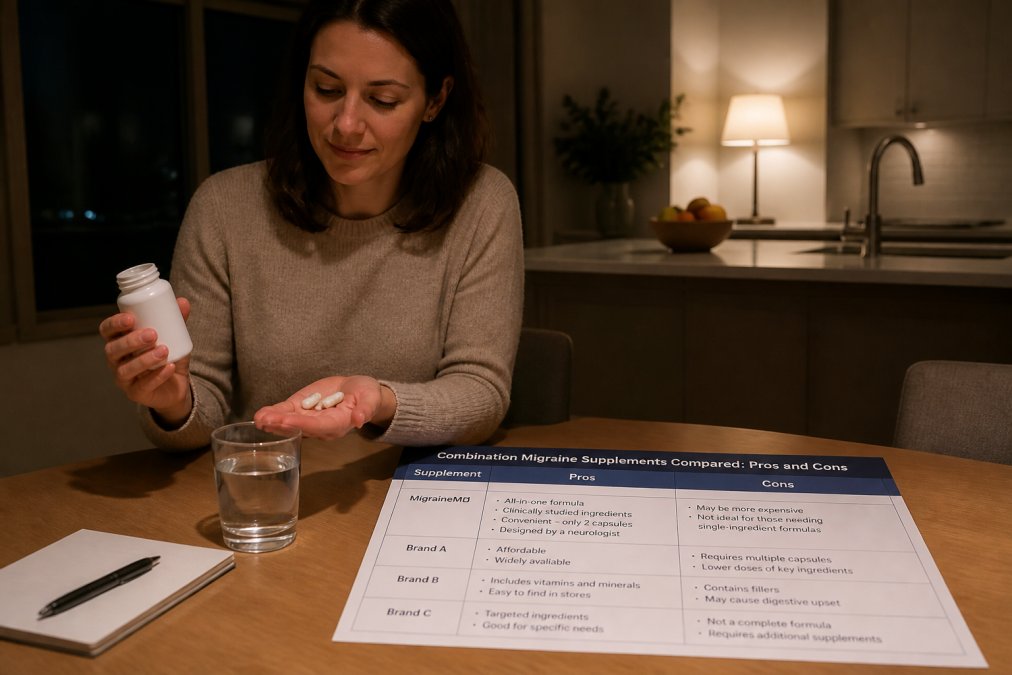
Combination Migraine Supplements Compared: Pros and Cons
Combination formulas differ mainly in ingredient count, dosing convenience, and whether they follow expert-recommended amounts. Here is a practical comparison.
Option |
Pros |
Cons |
Best For |
|---|---|---|---|
All-in-one, neurologist-developed, guideline-based doses, two nightly capsules, 3rd-party tested |
Premium product, premium price |
People wanting simplicity and the right ingredients at the right doses |
|
Individual bottles |
Full control over each dose and ingredient |
Up to 12 pills daily, easy to miss |
Detail-focused users |
Single-ingredient picks |
Lowest upfront cost |
Limited coverage, more guesswork |
Testing one nutrient at a time |
Budget multi-ingredient |
Lower price |
Often uses poorly absorbed forms, underdosed |
Cost-sensitive buyers |
Side Effects, Drug Interactions, and Who Should Ask a Doctor First
Most migraine supplements are well tolerated, but side effects and drug interactions are real. This is the section most buying guides skip, and it is the one your doctor will actually care about.
Common Side Effects by Ingredient
- Magnesium: Digestive upset is the main issue. Citrate and oxide are more likely to cause loose stools; glycinate is gentler.
- Riboflavin: Bright yellow urine is expected and harmless. High doses can occasionally cause nausea.
- CoQ10: Generally well tolerated.
- Feverfew: Mouth irritation, digestive upset, and a potential interaction with blood thinners.
- Melatonin: Drowsiness, nightmares
- Vitamin D3: Generally well tolerated.
Drug Interactions Most Guides Do Not Mention
This is where supplement stacking gets complicated, and where a conversation with your doctor or pharmacist matters most.
- Blood thinners (warfarin, apixaban, rivaroxaban, aspirin): Omega-3s at high doses and feverfew both have blood-thinning effects. If you take an anticoagulant or antiplatelet drug, clear these with your doctor first.
- Blood pressure medication: Magnesium can lower blood pressure slightly. If you are already on antihypertensives, watch for dizziness.
- Antibiotics and diuretics: Certain classes can deplete magnesium, which may actually increase your need for supplementation. Your pharmacist can flag this.
Who Should Ask a Doctor First
Talk to your doctor before starting any daily migraine supplement if you are pregnant, nursing, taking prescription medication, managing kidney disease, or have any other health condition. Kidney disease matters specifically for magnesium, because impaired kidneys clear it more slowly.
This is general information, not personal medical advice.
Frequently Asked Questions
What supplements are recommended by neurologists for migraine prevention?
National headache guidelines commonly point to magnesium, riboflavin (vitamin B2), and coenzyme Q10, as the core nutraceuticals for migraine prophylaxis. Feverfew appears in some protocols as an herbal option. Melatonin is now recommended by the updated Canadian Headache Society migraine prevention guidelines. The key is dose and form: magnesium glycinate or citrate at evidence-based amounts 400-600 mg, riboflavin at 400 mg, and CoQ10 at 100-300 mg per day. MigraineMD combines these ingredients at guideline-recommended doses in two nightly capsules, which removes the guesswork of matching individual products.
How long does it take for daily migraine supplements to work?
Most clinical trials measure outcomes at three months, not three weeks. Riboflavin and magnesium both build toward a therapeutic threshold over time, so headache frequency often shifts gradually rather than overnight. MigraineMD is formulated for nightly use, and the brand recommends taking it for at least 3 months for optimal results. If you are sensitive to new supplements, starting with one capsule nightly for two weeks before moving to two capsules can reduce the chance of stomach upset.
Is it better to take individual vitamins or a combination migraine supplement?
Individual supplements let you adjust one ingredient at a time, but they also mean more pills, more cost, and more chances to get things wrong. A combination formula like MigraineMD puts clinically studied ingredients into two capsules taken at bedtime, which suits people who already juggle a prescription preventative and want fewer moving parts. The trade-off is flexibility: if you react to one ingredient, a combination product is harder to isolate than single-ingredient bottles.
Are there any FDA regulations for dietary supplements regarding migraine relief?
In the U.S., dietary supplements are regulated by the FDA under the Dietary Supplement Health and Education Act (DSHEA) as a category of food, not as drugs. That means manufacturers are responsible for safety and labeling accuracy before a product reaches the market, and the FDA steps in after the fact if problems arise. Supplements cannot claim to cure migraine. Third-party testing is how many buyers verify that what is on the label matches what is in the bottle.
Frequent migraines cost you workdays, weekends, and peace of mind. A daily preventive routine can reduce how often attacks interrupt your life, and MigraineMD makes that routine simple: two nightly capsules, guideline-backed ingredients, a 90-day guarantee, and a formula developed by a neurologist. Get started with MigraineMD and take back your calendar.
Leave a comment